
Many Nashville homeowners add insulation to their homes, yet still battle with high energy bills, drafty rooms, and room temperatures that are too hot or too cold. What’s going on?
The culprit is air leaks. Insulation slows heat transfer, but it doesn’t stop air from leaking through gaps around it. When conditioned air leaks out and outside air sneaks in, your insulation can’t do its job. That’s the problem with air leaks in home envelopes, and it’s more common than most Nashville homeowners realize.
In our region’s warm, mixed-humid climate, air sealing needs are year-round. Hot, humid summers push moisture-laden air indoors. Chilly winters send drafts through every gap and crack. Building envelope air leakage accounts for 25 to 40% of your home’s heating and cooling costs, constantly working against your insulation.
The fix starts with professional air sealing in Nashville. This post explains what air sealing is, why your home needs it, and how spray foam can seal and insulate in one application.
What Air Sealing Is and Why Insulation Alone Isn’t Enough
 Air sealing your Nashville home means closing the cracks, gaps, and penetrations in your home’s exterior shell so conditioned air stays inside and outdoor air, moisture, dust, and allergens stay out.
Insulation and air sealing do two different jobs. Insulation slows conductive heat flow through walls, ceilings, and floors. Air sealing stops air from moving through and around those same surfaces. A home needs both, because even a thick layer of insulation underperforms when air flows freely through and around it.
Understanding why to air seal your home comes down to scale. The average house has small gaps and cracks that add up to roughly a 14-inch square hole, creating a constant path for energy loss, humidity, and pests. Understanding the difference in air sealing vs insulation is the first step toward a home that performs the way it should.
Locally, Nashville sits in IECC Climate Zone 3A, a warm/humid zone with hot, humid summers and mild, chilly winters. Metro Nashville’s building code is the 2024 IECC, adopted by the Metropolitan Government of Nashville and David.
How Spray Foam Seals and Insulates in One Step
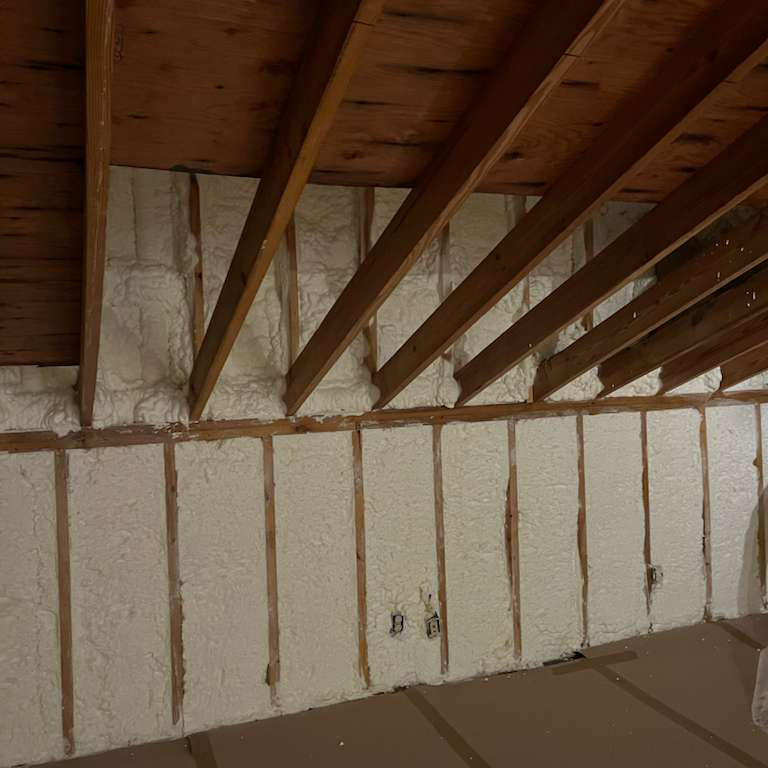
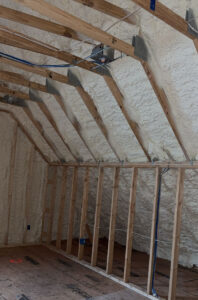 Spray foam insulation sets itself apart because of its air sealing properties. Traditional insulation, such as fiberglass, slows heat but needs a separate air-sealing step to reach its full potential. Spray foam handles both jobs in one application. It can be applied to open wall cavities, on attic surfaces, and under floors to insulate and reduce air leakage. The foam rapidly expands to fill even the smallest cavities, creating an effective air barrier while insulating. Take a deeper look at how spray foam insulation works.
When choosing between open cell vs closed cell spray foam, the right pick depends on where it’s going. Open-cell foam is flexible and vapor-permeable, making it well-suited for areas where moisture isn’t a problem. Closed-cell foam is denser, delivers a higher R-value per inch, and adds moisture-control properties, making it a better fit for crawl space walls and rim joists. In Middle Tennessee’s humid climate, controlling air leakage also helps manage moisture, so the choice matters.
The Payoff — Comfort, Lower Bills, and Better Air in a Mixed-Humid Climate
The results of proper air sealing are practical and measurable. The U.S. Environmental Protection Agency (EPA) estimates that air sealing, combined with added insulation, saves an average of 15% on heating and cooling costs (about 11% of total energy costs). For home energy efficiency conscious Middle Tennessee homeowners, that adds up quickly.
Attic air sealing is considered one of the highest-return places to start to help reduce drafts and energy bills in Middle Tennessee. Penetrations in your attic around top plates, recessed lights, and the access hatch are among the biggest sources of leakage in most homes. Pair attic sealing with the right attic insulation, and you’re addressing the area where losses are most concentrated.
It’s important to remember that a tightly sealed home needs controlled proper ventilation. Relying on random gaps or open doors and windows for fresh air can lead to poor indoor air quality. The recommended approach is whole-house ventilation, where you air seal as much as possible and add controlled mechanical ventilation. If your home has gas appliances, a professional should confirm proper ventilation and combustion safety. It’s also important to consult with a professional to map out leaks before adding insulation, so that sealing and insulation can work together properly.
Frequently Asked Questions
Seal Smart, Stay Comfortable
Insulation and air sealing work as a team. In Middle Tennessee’s warm-humid climate, sealing the envelope is what lets everything else do its job. Seal first, insulate smart, and let spray foam insulation Nashville homeowners trust do double duty where it makes sense.
Contact Hayes Insulation today to schedule an estimate. Our team provides air sealing and spray foam insulation for new and existing homes and buildings across Nashville, Murfreesboro, and the greater Middle Tennessee area. We are here to help you find and seal the leaks that are costing you comfort and money.
References
ENERGY STAR. “Air Sealing: Building Envelope Improvements.” U.S. Environmental Protection Agency, https://www.energystar.gov/ia/home_improvement/home_sealing/AirSealingFS_2005.pdf.
ENERGY STAR. “Why Seal and Insulate?” U.S. Environmental Protection Agency, www.energystar.gov/saveathome/seal_insulate/why-seal-and-insulate.
Metropolitan Government of Nashville and Davidson County. “Adopted Codes for Metro Nashville.” Department of Codes Administration, www.nashville.gov/departments/codes/codes-administration/adopted-codes-list.
National Renewable Energy Laboratory. “Tennessee Residential Energy Efficiency Potential.” ResStock, U.S. Department of Energy, https://resstock.nlr.gov/factsheets/TN
University of Missouri Extension. “Insulating and Weatherizing Your Home.” University of Missouri, extension.missouri.edu/publications/gh4881.
UpCodes. “Nashville and Davidson County Energy Code 2024.” https://up.codes/viewer/nashville/iecc-2024/chapter/RE_4/re-residential-energy-efficiency#RE_4.
U.S. Department of Energy. “Air Sealing for New Home Construction.” Energy Saver, www.energy.gov/energysaver/air-sealing-new-home-construction.
U.S. Department of Energy. “Air Sealing Your Home.” Energy Saver, www.energy.gov/energysaver/air-sealing-your-home.
U.S. Department of Energy. “Attic Air Sealing Guidelines.” Building Technologies Program, https://www.energy.gov/cmei/buildings/articles/attic-air-sealing-guide-building-america-top-innovation
U.S. Department of Energy. “Building America Climate-Specific Guidance.” Office of Energy Efficiency and Renewable Energy, www.energy.gov/cmei/buildings/building-america-climate-specific-guidance.
U.S. Department of Energy. “Insulation.” Energy Saver, www.energy.gov/energysaver/insulation.
U.S. Department of Energy. “Insulation Materials.” Energy Saver, www.energy.gov/energysaver/insulation-materials.
U.S. Department of Energy. “Types of Insulation.” Energy Saver, www.energy.gov/energysaver/types-insulation.
U.S. Department of Energy. “Whole House Ventilation.” Energy Saver, https://www.energy.gov/energysaver/whole-house-ventilation