
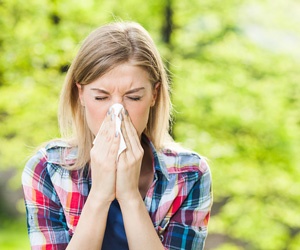
If you or someone in your household suffers from allergies or asthma, the air inside your home may be making symptoms worse. According to the U.S. Environmental Protection Agency (EPA), common indoor pollutants such as dust mites, mold, pet dander, and pollen are significant asthma triggers found inside homes.
Nashville’s humid subtropical climate and location in IECC Climate Zone 4A mean long allergy seasons, high pollen counts, and persistent humidity. The Tennessee Department of Health reports that asthma affects tens of thousands of Tennessee children and remains a leading cause of chronic illness in the state. In a climate like Nashville’s, managing indoor air quality is essential. Without proper air sealing, outdoor allergens and excess moisture enter through gaps in the building envelope and circulate throughout your home. The EPA also reports that Americans spend up to 90% of their time indoors, where these pollutants can accumulate.
Air sealing your Nashville home reduces the number of outdoor allergens, such as pollen, dust, and mold spores, that enter through cracks and gaps. When combined with proper insulation and humidity control, air sealing helps create a healthier indoor environment that can significantly ease allergy and asthma symptoms.
Not sure where your home is leaking air? A professional evaluation can identify hidden air leaks and recommend solutions to improve your indoor air quality.
How Air Leaks Bring Allergens Into Your Nashville Home
The Problem With Air Leaks
Every home contains small gaps around windows, doors, plumbing penetrations, attic hatches, recessed lighting, and where building materials meet. These openings allow unfiltered outdoor air, carrying pollen, mold spores, dust, and pest-related particles, to enter your living space.
 These allergens do not drift in once and then disappear. They continually infiltrate your home through pressure differences caused by wind, HVAC operation, and seasonal temperature swings.
The U.S. Department of Energy (DOE) states that reducing air leakage is one of the most cost-effective ways to improve comfort and create a healthier indoor environment. Addressing air leakage improves both comfort and overall home performance.
Why Nashville’s Climate Makes It Worse
Nashville’s hot, humid summers increase the amount of moisture entering through air leaks. High indoor humidity fuels mold growth and dust mite populations. The EPA recommends maintaining indoor relative humidity between 30 and 50 percent to minimize biological pollutants. Without proper humidity control, allergens can multiply indoors.
The University of Illinois Smart Energy Design Assistance Center notes that energy conservation code requirements are designed not only to improve efficiency but also to protect indoor air quality and prevent asthma-related health problems.
Uncontrolled air leakage does not just impact health. It also reduces energy efficiency during both hot summers and cold winters.
The Bigger Picture — Build Tight, Ventilate Right
Air sealing does not mean eliminating fresh air. The DOE emphasizes that sealing should be paired with proper mechanical ventilation. The goal is to seal uncontrolled leaks while intentionally introducing filtered air through your HVAC system. This “build tight, ventilate right” approach improves indoor air quality without sacrificing fresh air.
The University of Massachusetts Amherst notes that reducing the infiltration of outdoor allergens while managing indoor sources such as mold and dust can significantly alleviate symptoms. Upgrading to high-efficiency filters, such as MERV 13 or higher, further reduces common asthma triggers found in homes.
How Air Sealing and Insulation Improve Indoor Air Quality
Air Sealing: Your First Defense Against Allergens
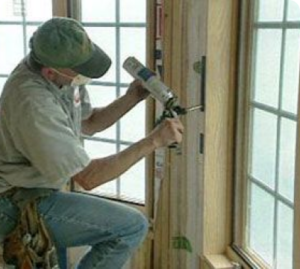 Air sealing closes the gaps that let unfiltered outdoor air in. When properly sealed, your home controls where air comes from and how it is filtered.
Reducing air leaks limits the entry of pollen, dust, and mold spores. The DOE confirms that air sealing reduces energy waste, improves durability, increases comfort, and creates a healthier indoor environment.
Once leaks are sealed, your HVAC system can function as designed. Instead of constantly conditioning incoming outdoor air, it filters and manages a controlled volume of indoor air. This improves overall filtration effectiveness.
Spray Foam Insulation: Insulating and Sealing in One Step
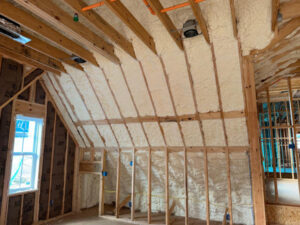 Spray foam insulation provides both thermal insulation and air sealing in a single application. Unlike traditional insulation, spray foam expands to fill cracks, joints, and irregular surfaces. This dual function makes it highly effective at both insulating and sealing. Closed-cell spray foam is moisture-resistant and provides a high R-value per inch. Reducing air movement and moisture intrusion, it helps limit the conditions that promote mold growth and dust mites.
The EPA’s Indoor airPLUS program highlights that properly sealed homes combined with enhanced filtration reduce exposure to potential asthma triggers.
Crawl Space Encapsulation: Stopping Moisture and Allergens at the Source
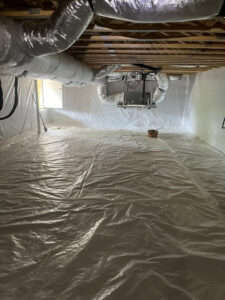 Many homeowners overlook the crawl space, yet unsealed crawl spaces allow soil moisture, mold spores, and pest allergens to migrate upwards into the home.
Encapsulation involves installing a vapor barrier and sealing the crawl space to create a controlled environment. This stops moisture migration at its source and reduces the movement of allergens into living spaces.
Colorado State University Extension identifies ground moisture as a key contributor to the formation of biological allergens and recommends controlling moisture entry by sealing and following proper building practices.
FAQ — Air Sealing, Allergies, and Indoor Air Quality
Healthier Air Starts With Sealing the Leaks
Air sealing and proper insulation are among the most effective ways to reduce indoor allergens, control humidity, and improve the air quality in your Nashville home.
Whether you suffer from seasonal allergies, asthma, or simply want a healthier living environment, addressing air leaks is a practical first step that also lowers energy bills.
Contact Hayes Insulation today to schedule a free estimate. Our experienced Nashville insulation team can assess your home’s air leaks and recommend air-sealing and insulation solutions to improve indoor air quality and year-round comfort.
References:
Colorado State University Extension. (n.d.). Improving air quality in your home. Colorado State University. https://extension.colostate.edu/resource/improving-air-quality-in-your-home/
Tennessee Department of Health. (n.d.). Asthma. Tennessee Healthy Homes Program. https://www.tn.gov/health/cedep/environmental/healthy-homes/hh/asthma.html
University of Illinois at Urbana-Champaign. (n.d.). Indoor air quality. Smart Energy Design Assistance Center. https://smartenergy.illinois.edu/indoor-air-quality/
University of Massachusetts Amherst. (n.d.). Allergies and air quality. Environmental Health & Safety. https://ehs.umass.edu/allergies-and-air-quality
U.S. Department of Energy. (n.d.). Air sealing your home. Energy Saver. https://www.energy.gov/energysaver/air-sealing-your-home
U.S. Environmental Protection Agency. (n.d.). Asthma and your health. https://www.epa.gov/air-quality/asthma-and-your-health
U.S. Environmental Protection Agency. (n.d.). Asthma triggers: Gain control. https://www.epa.gov/asthma/asthma-triggers-gain-control
U.S. Environmental Protection Agency. (n.d.). Indoor airPLUS and asthma. https://www.epa.gov/indoorairplus/indoor-airplus-and-asthma
U.S. Environmental Protection Agency. (n.d.). What are biological pollutants, how do they affect indoor air quality? https://www.epa.gov/indoor-air-quality-iaq/what-are-biological-pollutants-how-do-they-affect-indoor-air-quality